Powered by Blogger.

THE GRiT

MAYBANK Islamic Bhd is confident demand for its retail portfolio will grow well in Malaysia and it is poised to roll out more products next year as well.
Chief executive officer Datuk Mohamed Rafique Merican said things to watch out for were new products, product enhancement and improved customer experience. The globally-recognised bank is awaiting the green light for some of the regulatory processes.
“We can still grow in Malaysia because demand for Islamic finance products is strong, especially for retail, which makes up 61 per cent of the portfolio,” he said in an interview recently.
Its latest HouzKey, or rent-to-own using Ijarah leasing, is targeted to grow the portfolio by RM1 billion next year when it is opened to first-time house buyers and upgraders.
In Malaysia, the growth of Islamic finance outpaces that of conventional banking by 2:1.
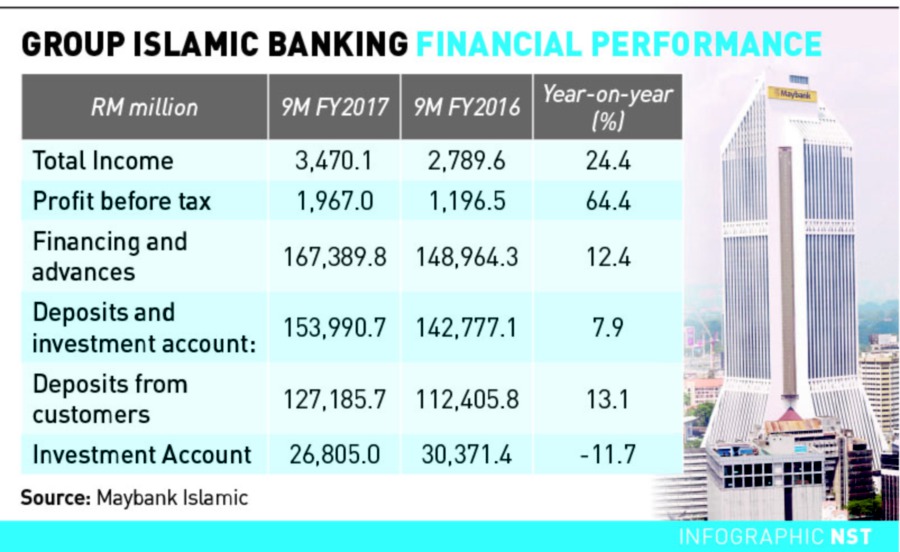
“The products in the retail space are there while more work needs to be done for investment products and those which embrace the Islamic contracts,” said Rafique.
Maybank Islamic, which adopted value-based intermediation, will develop a wakaf fund together with state councils in areas like economic empowerment, education, health and investment.
“The expectations are that Islamic banks adopt principles broader than pure banking and contribute back to the community either through direct funds (zakat) or wakaf,” he said, adding that the potential for wakaf could be sizeable.
Likewise, trade finance needs to be fully tapped and Malayan Banking Bhd (Maybank), as a global lender, is in the right position.
Rafique, who has helmed the bank for 18 months, said the trillion-dollar global halal market was still relying on conventional trade financing.
“We are working in that space based on the products in the halal market. It is a question of acceptance by the players, both exporters and importers.”
For example, global food company Nestle is now using conventional trade financing facilities as well as the Islamic option.
Islamic trade finance has offerings such as letter of credit-i, banking or shipping guarantee-i, inward bills collection-i, murabahah working capital financing and tawarruq trade financing.
Malaysia imports halal beef from Australia, of which some is re-exported to Gulf Cooperation Council member states, which makes it possible for Islamic trade facilities. Ten per cent of halal meat import comes from non-Muslim countries, and Rafique is confident that discussions can be held how to position halal trade and open certification for that purpose.
Maybank is present in 20 countries, and Maybank Islamic has been having engagements with Thailand and the Philippines as well as Kazakhstan, Afghanistan and Turkey.
Apart from growing interest from African regulators, Maybank is also likely to assist Sri Lanka introduce Islamic finance for some products.
In mid-October, Maybank walked away with the Best Global Islamic Financial Institution award at the Global Finance Awards in Washington.
It was also recognised as the Best Global Sukuk Bank and Best Global Provider of Syariah-Compliant Short-Term Investments.
For Maybank Islamic, even if the Islamic finance marketplace has been described as being overcrowded, it would prefer to stick to an organic growth path.
“While having a stronger capitalised financial institution would be a plus for the industry’s growth, choosing an organic or inorganic path is much dependent on where each entity is on its journey. Big for the sake of being big alone may not do it, there must be clarity about being big, what it means,” said Rafique.
Copyright New Straits Times
Share
Tweet
Pin
Share
No comments
Big Data, Cyber-Physical Systems, Data Analytical, and so forth are several terms close to Industry 4.0. This fourth generation of industrial transformation shifts the “traditional” industries by the Internet of Things, Data, and Services.

It can be said that almost all industrial sectors have undergone a change towards "digitalisation". In the nowadays world, it has been no difficulties for an individual to enter the retails industry by online shopping. In several countries such as Indonesia and United States, the existence of online shopping starts to threaten existing store economics and incentives.  

Traditional retailers are starting to live and die over the change from the new business cycle. It could happen since the operational costs incurred, the salaries paid for shopkeepers, or other such expenses paid by traditional stores are not required by online shopping because they may only require one admin on duty to receive every order coming through the website or social media. It is not necessary as well to raise millions of expenses on building and electricity as they can keep running their online store from small shophouses without decoration or even from their own home.

(Source: https://www.moovweb.com/mobile-commerce-trends-2016/)
The world of banking and financial services also began to undergo a radical transformation. The presence of internet-banking and branchless-banking has changed how retail-banking management is managed. The demand for branch offices is replaced by the presence of ATMs and the reliability of the internet-banking system. Many transactions conducted by banking consumers without going through a branch office.

Not only changes in the producer’s and consumer’s behaviour in business or trade, Industry 4.0 is like having cause-and-effect relation with the existence of Generation Y. Therefore, we will talk about this millenials generation on the next post.

Then, above those examples, we could know that this economic transition phenomenon is not only supports insdustries to go digitat, but also thinks about the displaced labor force as a result of competing in the industrial revolution 4.0. Especially, one of the characteristics of industrial revolution 4.0 is relative to capital intensive, solid technology, and labor non-intensive.

Within its unique characteristics coming up as trend in this century at digital age brings us to three form which are labor non intensive, capital intensive and technology intensive. Non Labor-Intensive, also known as liquid workforce, is a form of work needing less workforce or a little amount of work in relation to output. Companies are investing in the tools and technologies they need to keep pace with constant change in the digital era but there is typically a critical factor that is falling behind: the workforce. Companies need more than the right technology; they need to harness that technology to enable the right people to do the right things in an adaptable, change-ready, and responsive liquid workforce.  In short, business leaders are realizing their new liquid workforce can become their new competitive advantage. While Capital-Intensive refers to a business process or an industry that requires large amounts of money and other financial resources to produce a good or service. It is also requiring the investment of large sums of money. The advantages of capital intensive production is; can work 24/7 Quality of work is consistent, accurate and precise, can do work which is too dangerous and unpleasant for people. Then, technology-intensive production, on the other hand, is production that uses advanced technology to carry out tasks that otherwise would require (lots of) labor, or to perform tasks that no humans are able to do (for example, cell phone manufacturing).
Share
Tweet
Pin
Share
No comments
Older Posts

About Us

Photo Profile

We're a group of lovely students who always learn and we're thrilled you’re here—because we have so much that want to be shared with all of you. We're here to share the things we love and passionate about.

Blog Archive

  • ▼  2017 (14)
    • ▼  Dec (6)
      • Economics in The Dark Knight Movie
      • AIR ASIA vs MALAYSIA AIRLINES : MONOPOLY MARKET
      • CONCEPTUALIZATION OF THEORY OF MARKET PRICE IN ISL...
      • Which are the top Smartphone brands in Malaysia in...
      • Maybank Islamic: Lender upbeat on retail growth
      • Islamic Perspective in Consuming Quality Product
    • ►  Nov (4)
    • ►  Oct (3)
    • ►  Sept (1)

Categories

Malaysia Economy (5) Business Economics (3) Islamic Economics (3) Economy Nowadays (2)

Popular Posts

  • KL economy up 5.8% on robust exports, domestic demand
    ...
  • Industry 4.0?
    Big Data, Cyber-Physical Systems, Data Analytical, and so forth are several terms close to Industry 4.0. This fourth generation of industri...
  • Malaysia's 2018 Budget may boost stock market
    KUALA LUMPUR • Malaysia's government spending could revive gains in the stock market that is South-east Asia's worst performer des...

Total Pageviews

Followers

Created with by ThemeXpose