Powered by Blogger.

THE GRiT

Assalamualaikum. How are you? Hopefully you guys was in pink of health. Today, I would like to share a journal that have been writing by Nurizal Ismai with the topic Price theory from Islamic Perspective: Analysis from the earlier Muslim Scholar's thought . 
I love to share because I think this topic was interesting to be looked in different perspective. And I believe that the best of people are those who are most beneficial to the society. I hope by sharing this journal can improve our knowledge towards Islamic economy. Hope all of you can enjoy.
  
Ok. Before we go through the conceptualization of theory of market price in Islamic Economics, we need to understand and take noted what have been Islamic scholar thought about this matter.


PRICE THEORY FROM EARLIER MUSLIM SCHOLARS PERSPECTIVE


Actually some Islamic economics literature have been discussedand have described by the classical Muslim scholars were long before the emergence of schools of economics such as classical economics or the new classical economics. A description of the prices concept by earlier Muslim thinkers as follows:

1. Imam Abu Yusuf 

Real name is Yaqub ibn Ibrahim al-Ansari was born in  Kufa (Iraq) in the year 731A.D or 113 A.H. He occupied the highest position in law as the chairman of the judges(Qudhat al-Qudha) in the reign of Harun al-Rashid.Further his contributions to the fieldof economic thought can be seen from his book kitab al-kharaj´.In regard to the concept of price, Imam Abu Yusuf argued that the price is cheap not because of supply (supply)of food in the market that much, and the expensive price is not caused by a few food supplied. Abu Yusuf rejected the argument that states when supplies of goods increase,then prices will decrease or when the supply is limited, then the price will increase. The rise and fall in the market price according to him is the will of Allah SWT. Here we can see that the market determines the price not only lies on the demand side, but there are other factors that determine which is on the supply side.
For example, it was happened in the Amirul Mukminin Umar bin Khattab period, in which the price of corn during the period increased due to a bad season (natural factors). So the offer supply or demand in the economy is a mechanism of price formation through a policy of Allah SWT (the natural law).

2. Imam Shafi'i

Real name is Abu Abdullah Muhammad ibn Idris al-Shafi  i or Muhammadibn Idris ash-Syafi `I was born Gaza, Palestine, 150 H / 767 A.D. He was a great mufti Sunni sect of Islam and also the founder of the Shafi'I school. In regard to the concept of  price, Imam Shafi'i only describes briefly about the cause of the rising and falling prices in the market. According to him, the value of a commodity increase and decrease at anytime due to changes in price, and at less and more of human desire and the quality and number of goods.


From a brief explanation is understandable that there are some decisive factors that cause the value of a commodity or service subject to change, namely: human desire, change of price, quality and quantity of goods


3. Qadi 'Abdul Jabar

His real name is Abdul Jabbar Ibn Ahmad Ibn 'Abdul Jabbar al-HamaJani al-Asadabadi, who was born 935 A.D. He was a Mu'tazilite the ologian, a follower of the Shafi'i school. He lived in Baghdad, until he was invited to Rayy, in 367 AH/978 A.D, byIbn 'Abbad, a staunch supporter of the Mu'tazila. He was appointed chief Qadi of the province. On the death of Ibn 'Abbad, he was deposed and arrested by the ruler.In regard to his view on the price theory it can be traced from his book "Al-MughniAbwbfi al-Tawhid wal'Adl 
" in the chapter of prices, cheap and expensive,' Abdul-Jabar gives moredetails his concept of market price. The first explanation about is the provision of acommodity exchange that will be sold by pleasure way.
Furthermore, he divides the concept into two parts, namely the price on the concept of cheap and expensive in the market. The definition of cheap is a decrease in number according to the price, the custom prevailing at the time and place. 

Therefore, it cannot be equated ice price decreases in winter, which happens in the summer that the price becomes cheaper. On the other hands,decrease of ice price in cold regions cannot be regarded as cheap price in hot areas.The definition is expensive according to the price increase as customs prevailing at the time and place.

From the definitions and examples mentioned we need to know thecauses of rising and high prices of some goods. The price to be cheap because Allah SWTwho increases the commodities or goods of the particular period, then the quantity will become cheaper, Moreover, the price becomes cheaper due to Allah SWT to deduct or decrease need for something.
Because the other is Allah subtracting the number of people
 who want a commodity due to contain the disease. While the price is high due to AllahSWT subtracting the quantity of commodities or goods to the needs of a commodity or the number of requests for goods or commodities.
By these points it can be understood or inferred the explanation of Qadi 'Abdul Jabar on the concept of price that rise and fall of  prices is Allah who determines. We must obey Him and be grateful for every blessing that has been given by him.

4. Ibn Taymiyyah

His real name is Taqi ad-Din Abu 'l-Abbas Ahmad ibn  Abd al-Halim ibn  Abdas-Salam Ibn al-arrn Taymiya who was born in Harran in 1263 AD. Its contribution in the field of Islamic economic thought can be known through his book "Majmu al- Fataawa" and "Siyasa al-Syar'iyyah". According to Ibn Taymiyyah that something increases its demand, the price will increase, otherwise if a little demand. It is related to the few and the many needs or strong and weak demand. So when more and strong demand for something then it will increase the price compared to when the little and weak need not increase the price.


Furthermore, according to him that the human desire have a lot of difference and diversity, namely:

1. By many and few goods requested; people want the goods when the quantity is less than more.

2.By many and less demand of goods: when it is more demand of goods, the price will rise inversely when less demand of goods, the price will fall

3.Based on the few and the many needs, and strong and weak demand, so when many needs and strong demand, prices will rise slightly and inversely proportional to the weak need not increase the price.In addition, he says that the rise and fall in prices is not always due to an injustice (zulm) by certain individuals. Thus if desire for the good increases while its availability decreases, its price rises. On the other hand, if availability of the good increases and the desire of goods decreases, the price comes down. Accordingly, the causes of price are not only because of injustice, but also from other aspects or components which it is desire of human is created by Almighty Allah.

 5.Imam Ghazali

 His real name is Ab med Muammad ibn Muammad Ghazl was born in1058 A.D. In regard to the concept of price can be found in his book ³Ihya Ulumuddin´
.The price according to him when the demand of commodity decreases the price willdecrease. It is stated: ³if the farmer does not get a buyer for produce,the he sells at a very low price´
His awareness of market forces is evident when, concerning high food prices,he suggests that the price should be induced down by reducing demand, implying aleftward shift in demand curve. In addition, according to Ghan zafar and Islahi that Imam Ghazali already talked about equilibrium price which in the term known today.  
It was called in his book as just price.


From the description of classical scholars on the concept of price can be concluded that the price is determined by God as the Word of Prophet Muhammad: 

"So Allah SWT that determines a lot and at least demand a good or service and he also determines a lot and the least supply of goods and services on the market. 

The implications of the will of God it is to changes in commodity prices or goods and services.They agreed that the price changes are determined by the will of Allah SWT( sunnatullah process) are realized in the form of market price mechanism, namely: the first is when the demand increases for goods and services that are in the market will cause prices to rise and reverse the price will come down when demand for goods decreases in this case relates to the supply side.

Both are from the quantity of goods, when the quantity of goods or commodities on the market then the prices will come down and vice versa when the quantity of goods and commodities on the market a little then the price will goup (demand side). Third is the enabling factors that cause changes in prices, such as the human desire factor, quality factor for commodity goods, and natural factors. On the second point only Imam Abu Yusuf who do not agree, he said not all goods are abundant,the price will be low and vice versa are not all expensive when the price of scarce good sin the market. In essence he said the price of cheap and expensive is God Almighty who set out as described by 'Abdul Jabar.


Taking into consideration of two figures it can be derived by such explanation.Explanation in figure 1 is a clear that when the price decrease from P1 to P2, the demand of goods on the market will increases from Q1 to Q2. On the other hands, figure 2 is a supply curve that explains when the supply of goods increases from Q1 to Q2, the prices will rise from P1 to P2.
Both curves are transformed by the will of Allah.

Furthermore, by taking an example given by Imam Ghazali then will find the balance point between demand and supply curves. According to Imam Ghazali if farmers do not get the buyer of the goods, he will sell it at a cheaper price. See figure 3


At the price level P1, the number of goods offered by the seller amounts to QS, while the amount of goods demanded is QD1.
Because the farmer does not find a buyer, then he lowered the price at the point P2, so the number of buyers increased from QD1 becomes Q*, forming price equilibrium (E) is the meeting point between demand and supply items to be sold by farmers. This equilibrium price is determined by the will of Allah SWT (sunnatullah process).

Furthermore, the concept of price by western thinkers has a similarity with the earlier Muslim thinkers, but the difference is the secular and west ignores the role of religion in economic activity. 

Therefore, in the price theory, they mentions that the price will be formed adjusted naturally without any role of God the Almighty fornicators over everything in it. In Islam the price adjustment is determined by God Most Originator of all things. Although the actual price of Adam Smith is the market mechanism through invisible hand that encourages the formation of prices. According to him let alone adjust with reasonable price without any interference from the government because there will be invisible hand that will bring prices at the point of equilibrium.


But Adam Smith did not explain whose invisible hand that he meant. The fundamental difference can be seen from the economic worldview of both concepts. In Islam,
Tawhid is the main foundation of a human as a guidance for all economic activities while the view of secular and west that the reason are mainstream.


CONCLUSION


In fact, Islamic literature either in general or specific source, introduced the price theory in the tenth century as well as the modern concept of price which was introduced by western scholars in seventeenth century.
Both views have similarity concept in the demand and supply law and have the difference in the fundamental aspect of man(worldview).In the fundamental aspect, the price theory from Islamic perspective is different from secular and western point of view. The price according to Islam is determined by the will of Allah through certain causes or called sunnatullah
process, while secular system views that the price will find or adjust in equilibrium price in natural. So, the secular or western concept on the price ignores of God who determines the price. This economic worldview is just only grounded by the reason. On the other hands, Islam must be based on firstly on the revelation, and after that the reason.


Share
Tweet
Pin
Share
No comments

According to International Data Corporation (IDC)’s latest report, despite the whole Galaxy Note 7 fiasco last year, Samsung remains as the top smartphone brand in Malaysia. 

OPPO and Huawei takes second and third spot respectively, to make up the top 3 brands that took up more than 50% of the Malaysian market share in 2016. 

Compared to 2015, smartphone shipments in Malaysia had dropped by 5.9%. This could be due to various negative economic factors, which included the weakening of Malaysian Ringgit against the US Dollar, as well as the rising costs of living in Malaysia.


While smartphone shipments were generally on a decline on a yearly basis, in the last 3 months of 2016, smartphone shipments picked up. 

Samsung took first spot, taking up 32.8% of the market share, followed by Apple (13.1%) and OPPO (10.9%). Huawei and Asus filled up the fourth and fifth spot with 8.2% and 7.7% market shares respectively.
Samsung maintained its lead while selling 77.2% more phones than the same period in 2015. IDC attributed Samsung’s success to the popularity of its Galaxy J series which jives well with the budget conscious crowd. 
Apple’s launch of the iPhone 7 and 7 Plus in mid-October caused a spike in their market share in the last quarter. 
Rounding up the Top 3, OPPO made the largest growth in the fourth quarter, by having a 109.3% increase of market share over the same period in 2015, which IDC attributed to its marketing initiatives, focusing on few key products like the F1 series, which gained a large following among the selfie generation. 
Huawei remained solidly on 4th place in 2016Q4, with its Huawei P9 series remaining popular despite being almost a year into its release, while ASUS dropped to 5th place for the same period of time.


Looking at 2016 as an overall,
Samsung remained the best selling smartphone brand,with 34.3% market share, selling a total of over 3 million smartphones with a steady 17.2% growth. 


OPPO, the surprise entrant 

securing second place by took up 10.2% market share, selling 916,000 smartphones in 2016, with the highest growth of 66.8!


Huawei sold 852,000 smartphones in 2016, taking third place with 9.7% market share. ASUS, which shipped considerably less smartphones compared to the previous year, is placed fourth with 9.6% market share, a drop of 43.3% compared to 2015. This is partly due to its latest range of ZenFone 3 having higher price tags, which, whilst making a marked improvement over its predecessor, is probably priced a little higher compared to the more budget friendly ZenFone 2 which was released in 2015. Making up the Top 5 brands would be Apple at fifth spot with 8.1% of total market share.

Share
Tweet
Pin
Share
No comments
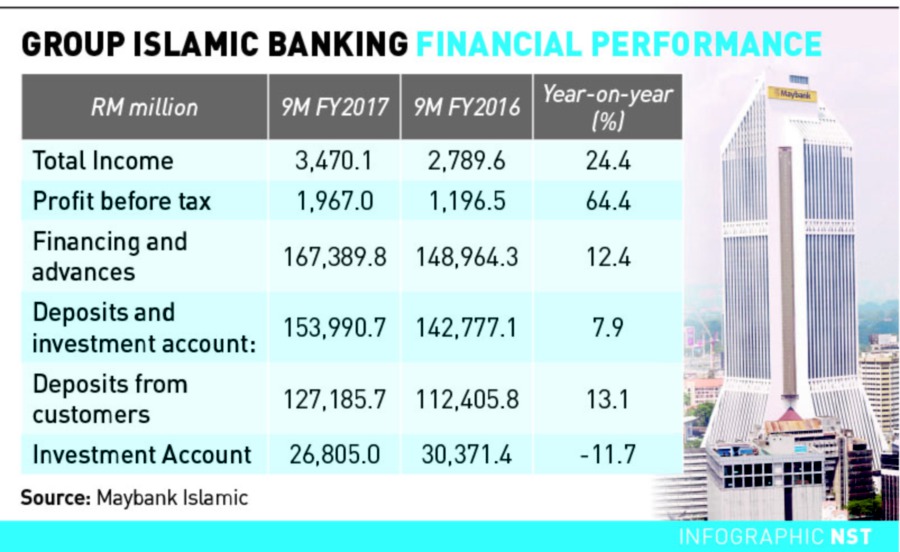
MAYBANK Islamic Bhd is confident demand for its retail portfolio will grow well in Malaysia and it is poised to roll out more products next year as well.
Chief executive officer Datuk Mohamed Rafique Merican said things to watch out for were new products, product enhancement and improved customer experience. The globally-recognised bank is awaiting the green light for some of the regulatory processes.
“We can still grow in Malaysia because demand for Islamic finance products is strong, especially for retail, which makes up 61 per cent of the portfolio,” he said in an interview recently.
Its latest HouzKey, or rent-to-own using Ijarah leasing, is targeted to grow the portfolio by RM1 billion next year when it is opened to first-time house buyers and upgraders.
In Malaysia, the growth of Islamic finance outpaces that of conventional banking by 2:1.
“The products in the retail space are there while more work needs to be done for investment products and those which embrace the Islamic contracts,” said Rafique.
Maybank Islamic, which adopted value-based intermediation, will develop a wakaf fund together with state councils in areas like economic empowerment, education, health and investment.
“The expectations are that Islamic banks adopt principles broader than pure banking and contribute back to the community either through direct funds (zakat) or wakaf,” he said, adding that the potential for wakaf could be sizeable.
Likewise, trade finance needs to be fully tapped and Malayan Banking Bhd (Maybank), as a global lender, is in the right position.
Rafique, who has helmed the bank for 18 months, said the trillion-dollar global halal market was still relying on conventional trade financing.
“We are working in that space based on the products in the halal market. It is a question of acceptance by the players, both exporters and importers.”
For example, global food company Nestle is now using conventional trade financing facilities as well as the Islamic option.
Islamic trade finance has offerings such as letter of credit-i, banking or shipping guarantee-i, inward bills collection-i, murabahah working capital financing and tawarruq trade financing.
Malaysia imports halal beef from Australia, of which some is re-exported to Gulf Cooperation Council member states, which makes it possible for Islamic trade facilities. Ten per cent of halal meat import comes from non-Muslim countries, and Rafique is confident that discussions can be held how to position halal trade and open certification for that purpose.
Maybank is present in 20 countries, and Maybank Islamic has been having engagements with Thailand and the Philippines as well as Kazakhstan, Afghanistan and Turkey.
Apart from growing interest from African regulators, Maybank is also likely to assist Sri Lanka introduce Islamic finance for some products.
In mid-October, Maybank walked away with the Best Global Islamic Financial Institution award at the Global Finance Awards in Washington.
It was also recognised as the Best Global Sukuk Bank and Best Global Provider of Syariah-Compliant Short-Term Investments.
For Maybank Islamic, even if the Islamic finance marketplace has been described as being overcrowded, it would prefer to stick to an organic growth path.
“While having a stronger capitalised financial institution would be a plus for the industry’s growth, choosing an organic or inorganic path is much dependent on where each entity is on its journey. Big for the sake of being big alone may not do it, there must be clarity about being big, what it means,” said Rafique.
Copyright New Straits Times
Share
Tweet
Pin
Share
No comments
Abstract
Consumerism is an important aspect and the nearest thing with daily human life that is needed to be addressed to achieve the goals of good in the world and the hereafter for all human especially for Moslem who has been handled by Al-Qur’an and Sunnah. The purpose writing this article is to discuss a topic “Islamic Perspective in Consuming Quality Product”  related to consumer behaviour and Islam views to give more understanding and awareness about consuming good quality product by using literature review from main sources of Islam, previous researchers, and discussion. The findings of this article are quality products occupy an equally important position in Islam as well as in human life on the consumption of a product viewed from how perspective the Islam, its advantages, and the intentions given by that person.
Keywords: Quality product, Consumer behaviour, Islamic perspective, Consumption

Introduction        
                              

Quality is part and parcel of human life in order to largely measurement of anything. This word become buzzword these days and many people talk about quality since they know the adverse will happen due to error of its quality, increase quality of life in self-improvement,  quality of public health, quality control and management, quality tested of goods, quality food, and so on, virtually people have high interest to get something which is good. For example, for the results, usually keep the quality as the desired end result. At the end of every year, usually people or companies, will calculate: what has been done this year and what improvements can be done next year. The person or company  evaluate the performance that he got and see the quality of its performance is where a more difficult goods achieved compared with the performance itself. In this case it can be seen that quality is ultimately a reference to the achievement of performance itself. Another example, in consuming something will refers to quality product which is also have expectation when they consume quality product that renders fulfill that good as they expected. Quality becomes something to be expected at the beginning and the end result. In this discussion generally will discuss the expected quality in the beginning that gives good results, in the end, especially discussing the consumption of quality products and its Islamic perspective.

Discussion

Quality is generally defined as the most favourable conditions, ideal, conforms to the requirements specified and to the satisfaction of all parties. Nevertheless, few understand the true meaning of the word quality and fewer still are able and willing to put quality in its true perspective in the changing context of the liberalization and globalization where the national boundaries for freer trade and commerce are slowly, but surely, breaking down. In the olden times, quality has a simple definition - a product or service should fit the purpose for which it was intended. For example, a part should fit another part without much effort. But nowadays. In addition, Evans and Lindsay (2007) argued the notion of quality evolves to become no longer universal along with the growth and maturity of the profession. According to a study asking about the definition of quality to the manager of 86 companies in the eastern part of the United States that produced several answers which are related to customer satisfaction, product design and operating performance. The notion of quality that remains popular today, which is based on consumer guidance, is that quality meets or exceeds consumer expectations.

Obviously, the meaning of quality in  Islamic perspective decidedly different from the usual meaning given by Western researchers. In Islamic, the views of quality as not only to productivity alone but involves questions of morality and character development which means that pursuing the pleasure of Allah s.w.t by combining the materially and spiritual reward. Dusuki (2007) in his writing said that quality is not measured by rating scales of human or “utilitarian” but also depends on the condition and measurement of the pleasure of Allah. The term “quality” from an Islamic perspective is very closely associated with the concept of blessings (Salleh, 2003). Another study gives the specific explanation about quality as the ability to meet customer requirements in terms of standards that have been set in terms of production. He also added the services offered must be included with ethical values such as courteous, punctuality, speed and accuracy with no defects ( Kamri, 2008).

Beside that, another author also explained about this, Afzal al-Rahman (1991), the standard of purity is one of the important aspects of consumption. He concluded that Islam argues its followers to only use items that are pure and good. In addition, he also stated his opinion that all words referring to the good products as stated in the Quran means every matter that brings pleasure and joy to the consumer is subjected to the limitations of law. In this case, Hassan (1995 ) explained that Islam views quality as a process that brings positive changes towards excellence in every human effort as our prophet words:

”Narrated Syaddad bin Aws: the two of Allah’s Apostle (PBUH)that I’ve taken care if has said: “Verily, Allah commands excellence in all things...”

Moreover, Mat and Ghani have talked about the importance of quality based on the hadith of the prophet, which means:

“Verily, Allah loves us when we do things with itqan.” (Hadith Narrated by Baihaqi)

Islam emphasized the importance of quality and treasured it more than the quantity, because the good quality-from peoples and from deeds-even if it is small in quantity, its effect will be great. Also, the large quantity without good quality has very little effect if any. We have to filter which one is good and which one is bad that have to leave because the most number does not guarantee the truth. If we look into the Qur’an, we will find many verses in which Allah scolds the large majority of people, because this majority was from those who do not think, or do not know, or do not believe, or do not give thanks. It is the clear word of Allah s.w.t:

"But most of them (mankind) have no sense." (Surah Al-Ankabut: 63),
"But most of the mankind don’t know" ( Surah Al-Araf: 187), "But most of the mankind don’t believe." ( Surah Hud: 17),
 "But most men don’t give thanks." (Surah Al-Baqarah: 243),

Allah (S.W.T.) also said to his prophet Muhammad (S.A.W.) and to every believer till the Day of Judgment in Surah Al-Ana’am, (verse 116), what can be translated as,

"And if you obey most of those on earth, they will mislead you far away from Allah’s Path."

Thus, the majority of people are not with the truth, and this is an important fact which confirmed by the Qur’an. In consuming, majority people do not consider their quality even virtually it gives the good impact, safe, reliable, and long-lasting. Cruz ( 2015), using quality products gives the safety and product quality is not only beneficial to these customers but also advantageous to the manufacturing industry. It should be clearly understood that quality is an attitude of mind and a way of life where “excellence is a journey, not a destination.” Personally, I put this thought as my principle in way of life to what I get is coming from the optimum what I do especially in consuming I put high priority to give the best to myself. Besides that, Maqasid al-Shariah, as the fundamental for the best life, strengthens of mind to give the best. Literally, the Maqasid al-Shariah can be defined as a whole for shariah purpose or a point. It is aimed at the purpose of the prohibition that is able to produce maslahah (kindness) to the people and to prevent harm. Maqasid syari'ah as agreed by the scholars is to maintain five very vital aspects of human life. The five aspects are to preserve religion (hifz al-din), soul (hifz al-nafs), intellect (hifz al-aql), heredity (hifz al-nash) and wealth (hifz al-mal). Whereas the relationship between maqasid and Malahat is a symbiotic relationship.

President of Malaysian Islamic Youth Forces (ABIM), Amidi Abd Manan in an interview by Selangor Journalist now, Hafizan Taib said Maqasid Syariah is a perimeter of the quality of society. For example, for hifz al-nafs (self-preservation), which is related is the quality of health services. It's not just life-threatening from the threat of murder but should be seen from healthcare glasses through all means and efforts. Food quality, for example, is also contained in self-preservation. Therefore, consuming quality product is the way to fill the fundamental for the best of life. The way to keep life in Islam by eat the forbidden only for necessity mentioned in Qur’an:

“While He has explained to you in detail what is forbidden to you, except under compulsion of necessity?” (Surah Al an’am :119)

Eating, drinking, clothing and housing:

“O Children of Adam! Take your adornment (by wearing your clean clothes), while praying and going round (the Tawaf of) the Ka'bah, and eat and drink but waste not by extravagance, certainly He (Allah) likes not Al-Musrifun (those who waste by
extravagance).”[Surah Al- A’raf :31]


The consumer perception in quality product is influenced by many factors, Agyekum et al ( 2015) found that consumers have different ideas or perception on the product quality based on their ages, income levels, and, educational background and this goes a long way to influence them on the criteria used in determining the quality of product when making a purchase. In this study, limitation and scope of this topic obviate those factor while determining their purchasing to consume, just to know the intention while all those are not arising.

Many things about quality always take precedence over our daily lives. Rice is not falsified, the transport is safe and reliable, the food we consume does not contain harmful substances and others. All these assumptions will become chaotic if something goes wrong. For example, an unscrupulous trader mixes harmful substances in cooking. Oil that turns deadly and leads to serious illness or death. Air travel is generally safe but small pilot errors can be disastrous with tragically hundreds of passengers. As such, we have taken quality as being reliable and safe in whatever activity we are involved. Taken, for example, sports equipment that we exercise. If a minor problem exists unnoticed, then someone sometime is bound to face a serious injury. In these days of technological inventions, supposed to improve the quality of life, quality is given a high degree of importance as one mistake could put an end to that invention in which millions of money have been invested. A responsible and intelligent customer always chooses a quality product and is reliable because he knows the quality of the Product/service will last as long as the customer has it, while the paid price is forgotten in a short time. It is wise to remember what W.A. Foster a few years ago: 

“Quality is never an accident. It is always the result of high intention, sincere effort, intelligent direction and skilful execution. It represents the wise choice of many alternatives.”. 

Therefore, from most researchers finding from literature review and discussion, the quality gained from the expectations that he created if it manifests from paying for some price, he will do beside it gives the value of 'self-esteem'. Thus, people actually have high intention to consume quality product unless nothing consideration in income as usual.

Conclusion

The quality meaning in  Islamic perspective decidedly different from the usual meaning given by Western researchers. In Islamic, the views of quality is as not only to productivity alone, but involves questions of morality and character development which means that pursuing the pleasure of Allah s.w.t by combining the materially and spiritual reward while in general quality defines as the most favorable conditions, ideal, conforms to the requirements specified and to the satisfaction of all parties, in popular until nowadays define quality as meets or exceeds consumer expectations. From main sources of Islam, consuming the quality product is recommended while there are other perceptions putting quality as an attitude of mind and by consuming the quality product is one of the ways to preserve the self or hifz al nafs which means we could save our life and our self that is a trust from Allah giving us this body. We have to save it as well we can do.


References

Evans James R., Lindsay William M., 2007, An Introduction to Six Sigma & Process Improvement, Thomson South-Western, Singapore
Dusuki, A. W., 2007. Why Do Malaysian Customers Patronize Islamic Banks?. International Journal of Bank Marketing, 25(3): 142-160.
Salleh, M.S., 2003. 7 Prinsip Pembangunan Berteraskan Islam. Kuala Lumpur: Zebra Editions Sdn. Bhd, pp:75.
Afzal al-Rahman, 1991. Doktrin Ekonomi Islam. (trans.) Zaharah Salleh, v. 2. Kuala Lumpur: Dewan Bahasa Dan Pustaka, pp: 11-13.
Hassan, N.M.N., 1995. An Islamic Approach to Quality and Productivity. In Quality and Productivity, ed., Al-Habshi, S.O. Kuala Lumpur: Institut Kefahaman Islam Malaysia.
Al-Nawawi, 1994. Shahih Muslim bi-syarh al-Nawawi, Kitab al-Sayd wa al-Dhaba’ih, Bab al-Amr bi Ihsan al-Dhabh wa al-Qatl, no. Hadith 5028.
Arif, S., Ahmad. R., 2011. Food Quality Standards in Developing Quality Human Capital: An Islamic Perspective. African Journal of Business Management Vol. 5(31), pp. 12242-12248, 7 December 2011. ISSN 199308233
Cruz, Albert V., 2015. Relationship between product quality and customer satisfaction. Walden Dissertations and Doctoral Studies. Walden University. Walden University ScholarWorks.
Agyekum, Crentsil K., Haifeng, Huang,.  Agyeiwaa, Amma,. 2015. Consumer Perception of Product Quality. Microeconomics and Macroeconomics  
Minda Presiden. 2015. http://www.abim.org.my/profil/minda-qiyadah/item/652-kepentingan-maqasid-syariah.html Access on Friday 24 Nov 2017


Share
Tweet
Pin
Share
No comments


Fresh fish. It is something that we're accustomed to here in Malaysia. Fish in Malaysia is one of our staples for protein, either cooked in our favorite sweet and sour sauce, steamed with ginger and oyster sauce or made into otak-otak, it is something that always seems to be around when we think of food.

However, if you try to look from an economic point of view, the fresh fish market is one of the good example for oldest perfect competitions in our love country. It is not only about a fish was selling in market, but it is also being a part of the tradition and lifestyle for almost fishermen who have the skills for catching fish and then passing down for next generations.


Being in a perfect competition, there is a very large amount of fishmongers in Malaysia, and all of them are selling the same thing, fish .


The fresh fish market is a very open market, as long as you have the fish to sell, you're set. All you have to do is rent a stall at a local market and you can start running your business. However, the value of pricing is very important when you're selling a fresh fish. 

The sellers must do some observation and analyze the currency value of price in the market price as they are act as price takers and  have no market power, so if you put the value of price selling overcharge for your fish, you'll probably run out of business very soon because the buyer have the information what the currently market price of fish. They have the choice to buy the fish freely and choose the most affordable price.

Now, let's together try to understand economic language regarding this topic. How economist see this matter? 

Perfect competition was defined as the opposite of a monopoly, in which only a single firm supplies a particular good or service, and that firm can charge whatever price it wants because consumers have no alternatives and it is difficult for would-be competitors to enter the marketplace.

Under perfect competition, there are many buyers and sellers, and prices reflect supply and demand. Also, consumers have many substitutes if the good or service they wish to buy becomes too expensive or its quality begins to fall short. New firms can easily enter the market, generating additional competition. Companies earn just enough profit to stay in business and no more, because if they were to earn excess profits, other companies would enter the market and drive profits back down to the bare minimum. 


Now, get back to the topic. Supplier of fish is not something you need to worry about, because after all, the sea is always there, so there will always have the fish, right?
Well,
when you think about it like that, actually many factors can affect the supply in the fresh fish market. 

For example, the weather. During the heavy rain season in Malaysia, supplier of fish is heavily reduced, as fishermen cannot go out to sea to catch the fish. At that point, the demand would surpass the supply, and the price of fish would increase. This will result in a shortage of fish in Malaysia.

Another example is Chinese New Year. This year during the festivities, the supply of fresh fish was drastically deducted at wet markets in the cities as the majority of Chinese wholesalers were celebrates on their Chinese New Year Holiday. Tenggiri fish were being sold between RM26 and RM27 per kilogram , Sardines between RM5-RM9, Tuna fish between RM6-RM7 and prawns between RM19-RM26 per kg depending on size. These prices are RM1-RM1.50 above from their market equilibrium prices, but people still bought them because of the demand still exist.


The laws of demand and supply dictates that when prices increase, demand will decrease. But in this case, demand did not decrease. This is because, being a festive season, this was a special case. During Chinese New Year, Chinese families have family dinners and banquets where fish is usually served, and during that time of celebration, they omitted the increment in the prices for fish. This goes to show that many factors are able to influence a perfect competition and we can't just follow the generic rules of demand and supply when  we analyze the market.

Producers in the fresh fish market earn normal profit. At this point, the fresh fish sellers are putting all their resources to the best use, working at full efficiency.  The overall goal of the fishmongers is to maximize their economic profit while minimizing their costs.

Written by Cheryl Chai Hui Yih (0314945)
Edited by Nurul Syafiqah bt Mohd Nasir 

References: 
http://www.themalaysianinsider.com/malaysia/article/low-fish-supply-prices-up
http://www.slideshare.net/mrtopf11/unit-2-3-2-perfect-competition-3427628
http://staffwww.fullcoll.edu/fchan/Micro/4perfect_competition.htm

Share
Tweet
Pin
Share
No comments

Malaysia Unemployment Rate 


The unemployment rate in Malaysia fell to 3.4 percent in September of 2017 from 3.5 percent in the same month of the previous year. The number of unemployed persons increased by 0.4 percent from a year earlier to 514,500 while the number of employed persons went up more by 2.1 percent to 14,544,300. The labour force rose 2 percent to 15,058,800 persons. On a seasonally adjusted basis, the jobless rate increased to 3.5 percent from 3.4 percent in the preceding month. Unemployment Rate in Malaysia averaged 3.28 percent from 1998 until 2017, reaching an all time high of 4.50 percent in March of 1999 and a record low of 2.70 percent in August of 2012.


What is 'Unemployment' ??

Unemployment is a phenomenon that occurs when a person who is actively searching for employment is unable to find work. Unemployment is often used as a measure of the health of the economy. The most frequently measure of unemployment is the unemployment rate, which is the number of unemployed people divided by the number of people in the labour force.

BREAKING DOWN 'Unemployment'
While the definition of unemployment is clear, economists divide unemployment into many different categories. The broadest two categories of unemployment are voluntary and involuntary unemployment. When unemployment is voluntary, it means that a person has left his job willingly in search of other employment. When it is involuntary, it means that a person has been fired or laid off and now must look for another job. Digging deeper, unemployment, both voluntary and involuntary, is broken down into three types.

Frictional Unemployment
Frictional unemployment arises when a person is in-between jobs. After a person leaves a company, it naturally takes time to find another job, making this type of unemployment short-lived. It is also the least problematic from an economic standpoint. Arizona, for example, has faced rising frictional unemployment in May of 2016, due to the fact that unemployment has been historically low for the state. Arizona citizens feel confident leaving their jobs with no safety net in search of better employment.

Cyclical Unemployment
Cyclical unemployment comes around due to the business cycle itself. Cyclical unemployment rises during recessionary periods and declines during periods of economic growth. For example, the number of weekly jobless claims in the United States has slowed in the month of June, as oil prices begin to rise and the economy starts to stabilise, adding jobs to the market.

Structural Unemployment
Structural unemployment comes about through technological advances, when people lose their jobs because their skills are outdated. Illinois, for example, after seeing increased unemployment rates in May of 2016, seeks to implement "structural reforms" that will give people new skills and therefore more job opportunities.

Differences in Theories of Unemployment
Many variations of the unemployment rate exist with different definitions concerning who is an "unemployed person" and who is in the "labour force." For example, the U.S. Bureau of Labor Statistics' commonly cites the "U-3" unemployment rate as the official unemployment rate, but this definition of unemployment does not include unemployed workers who have become discouraged by a tough labour market and are no longer looking for work.

Additionally, various schools of economic thought differ on the cause of unemployment. Keynesian economics, for example, proposes that there is a "natural rate" of unemployment even under the best economic conditions. Neoclassical economics, on the other hand, postulates that the labour market is efficient if left alone but that various interventions, such a minimum wage laws and unionisation, put supply and demand out of balance.

So, here I include 7 WAYS; HOW TO PREVENT UNEMPLOYMENT :)

1) Work the job you want after college, during college. When you start looking for jobs in four years, employers are going to be concerned about one thing — your resume. Start getting the experience you need from day one. Even if it isn’t the job you ultimately want, find a part time position that will allow you to build the skills needed for your dream job.

2) Get to know your professors. These individuals have been in the field a lot longer than you, and they know a lot more people who can help you to achieve your goals. Go to your professors for advice and guidance, and they will be your advocates.

3) Practise showing up. In the real world, you don’t get to sleep in through a meeting, so don’t train yourself in college to think it’s okay to sleep in through a class. Your education is your job right now — are you treating it that way?

4) Go for internships. They may not pay, but the experience you will receive will be invaluable when you are applying for jobs in the future.

5) Shadow as often as you can. Students frequently change majors or leave their program because they aren’t sure whether it’s something they’ll like doing in the real world. Don’t wait until last semester of senior year to decide you hate your major — call and ask to shadow someone who is on your desired career path to gain insight and a new friend in the field.

6) Remember why you’re there. College is the most flexible time of your life. You have few responsibilities to others and you are completely in control of your schedule. You get decide how you spend the 20 hours you’re not in class. Will you spend it building towards your future or playing video games?

7) Be a leader. Every company is looking for strong leaders, but the only way you can become one is through practice. Become the editor of the school paper, the captain of a team, or run for student government. If you can’t find a position that interests you on campus, start your own club, and know that future employers will see you as an innovative self-starter.


Share
Tweet
Pin
Share
No comments
Big Data, Cyber-Physical Systems, Data Analytical, and so forth are several terms close to Industry 4.0. This fourth generation of industrial transformation shifts the “traditional” industries by the Internet of Things, Data, and Services.

It can be said that almost all industrial sectors have undergone a change towards "digitalisation". In the nowadays world, it has been no difficulties for an individual to enter the retails industry by online shopping. In several countries such as Indonesia and United States, the existence of online shopping starts to threaten existing store economics and incentives.  

Traditional retailers are starting to live and die over the change from the new business cycle. It could happen since the operational costs incurred, the salaries paid for shopkeepers, or other such expenses paid by traditional stores are not required by online shopping because they may only require one admin on duty to receive every order coming through the website or social media. It is not necessary as well to raise millions of expenses on building and electricity as they can keep running their online store from small shophouses without decoration or even from their own home.

(Source: https://www.moovweb.com/mobile-commerce-trends-2016/)
The world of banking and financial services also began to undergo a radical transformation. The presence of internet-banking and branchless-banking has changed how retail-banking management is managed. The demand for branch offices is replaced by the presence of ATMs and the reliability of the internet-banking system. Many transactions conducted by banking consumers without going through a branch office.

Not only changes in the producer’s and consumer’s behaviour in business or trade, Industry 4.0 is like having cause-and-effect relation with the existence of Generation Y. Therefore, we will talk about this millenials generation on the next post.

Then, above those examples, we could know that this economic transition phenomenon is not only supports insdustries to go digitat, but also thinks about the displaced labor force as a result of competing in the industrial revolution 4.0. Especially, one of the characteristics of industrial revolution 4.0 is relative to capital intensive, solid technology, and labor non-intensive.

Within its unique characteristics coming up as trend in this century at digital age brings us to three form which are labor non intensive, capital intensive and technology intensive. Non Labor-Intensive, also known as liquid workforce, is a form of work needing less workforce or a little amount of work in relation to output. Companies are investing in the tools and technologies they need to keep pace with constant change in the digital era but there is typically a critical factor that is falling behind: the workforce. Companies need more than the right technology; they need to harness that technology to enable the right people to do the right things in an adaptable, change-ready, and responsive liquid workforce.  In short, business leaders are realizing their new liquid workforce can become their new competitive advantage. While Capital-Intensive refers to a business process or an industry that requires large amounts of money and other financial resources to produce a good or service. It is also requiring the investment of large sums of money. The advantages of capital intensive production is; can work 24/7 Quality of work is consistent, accurate and precise, can do work which is too dangerous and unpleasant for people. Then, technology-intensive production, on the other hand, is production that uses advanced technology to carry out tasks that otherwise would require (lots of) labor, or to perform tasks that no humans are able to do (for example, cell phone manufacturing).
Share
Tweet
Pin
Share
No comments
Newer Posts
Older Posts

About Us

Photo Profile

We're a group of lovely students who always learn and we're thrilled you’re here—because we have so much that want to be shared with all of you. We're here to share the things we love and passionate about.

Blog Archive

  • ▼  2017 (14)
    • ▼  Dec (6)
      • Economics in The Dark Knight Movie
      • AIR ASIA vs MALAYSIA AIRLINES : MONOPOLY MARKET
      • CONCEPTUALIZATION OF THEORY OF MARKET PRICE IN ISL...
      • Which are the top Smartphone brands in Malaysia in...
      • Maybank Islamic: Lender upbeat on retail growth
      • Islamic Perspective in Consuming Quality Product
    • ►  Nov (4)
    • ►  Oct (3)
    • ►  Sept (1)

Categories

Malaysia Economy (5) Business Economics (3) Islamic Economics (3) Economy Nowadays (2)

Popular Posts

  • KL economy up 5.8% on robust exports, domestic demand
    ...
  • Industry 4.0?
    Big Data, Cyber-Physical Systems, Data Analytical, and so forth are several terms close to Industry 4.0. This fourth generation of industri...
  • Malaysia's 2018 Budget may boost stock market
    KUALA LUMPUR • Malaysia's government spending could revive gains in the stock market that is South-east Asia's worst performer des...

Total Pageviews

Followers

Created with by ThemeXpose